Muay Thai for Self-Defense: Why Being Good at Fighting Isn’t Enough
Back when I trained stick fighting with Master Mario Gajo, they incorporated Thai boxing into their stick work. There were a couple of times when I got to move around while someone held mitts, and I really enjoyed it.
Then Master Mario brought in Coach Melchor Menor to teach a seminar on low kicks. It was one of the best seminars I’d ever attended. Everything was broken down so cleanly that I could immediately see the quality of his instruction.
That seminar put Coach Mel on my radar.
In November 2012, my wife and I went on our honeymoon. The hotel we stayed at happened to be right next to Art of Eight, Coach Mel’s gym.
Naturally, I couldn’t help wandering in to check the place out.
Mel wasn’t there teaching, but I watched his coaches, and it looked like a solid program. I got the information, listened to the sales pitch, and seriously considered signing up.
Then I remembered I was about to become a dad, and I was already barely paying the bills with my martial arts school.
So I figured I’d find a way to train Thai boxing someday.
Getting My Ass Kicked and Learning to Manage Fear
A few months later, after I stopped training kung fu and started Brazilian jiu-jitsu, I met Jesus Quiroz at SDBJJ.
I don’t think Jesus thought much of me initially. I was a reality-based self-defense guy just getting into jiu-jitsu, with a little wrestling background.
One day, we were moving around together, and something was off with Jesus. I don’t know what it was, but he decided we were going pretty much full contact.
This is something I still struggle with today.
When someone is teaching me something, I tend to second-guess myself. I trust their understanding of what we’re doing over my own instincts, even when something doesn’t feel right.
So I assumed we were going full contact for a reason.
I think I walked away with the worst concussion of my life.
After that, Jesus and I were pretty cool. I don’t know if he thought much of my Thai boxing, but he knew I could take a beating, and that seemed to be enough for him.
I loved training with Jesus because he was big into high-intensity interval training. He pushed himself hard, constantly working on his conditioning and anaerobic capacity.
It reminded me of my twin brother, who was heavily into CrossFit.
Conditioning was something I already valued from stick fighting, and it’s something we emphasize in the SPEAR System.
Your aerobic conditioning helps get you to the fight. Your anaerobic conditioning helps get you through the fight. And your aerobic conditioning helps get you home.
Being in shape matters.
But being in shape and being able to fight are only parts of self-defense.
Coach Mel: What a Real Coach Looks Like
When I moved to Rancho Bernardo in 2014, getting to SDBJJ became a pain. My instructors also kept changing in the Tuesday and Thursday classes I attended.
Still, I trained regularly and eventually made it to purple belt.
Then my twin brother died.
Around that same time, I found out Coach Mel was no longer running Art of Eight. He was actually teaching just one street over.
I reached out to see if he’d take me on as a student.
He did.
And I don’t think he realizes how much that decision changed my life.
I admire Tony Blauer’s SPEAR System tremendously, but I don’t think I ever would have had the courage to pursue it, or anything else outside combat sports, if it hadn’t been for the fear management I learned from Coach Mel.
After my twin brother died, getting back into training wasn’t easy.
Mel understood that.
He even came to my school and held mitts for me so I could psychologically ease myself back onto the mat.
He didn’t just teach me how to punch and kick.
He helped me get back in charge of myself.
He gradually exposed me to more pressure, more contact, and more discomfort, always working with me as an individual.
That’s what a real coach does.
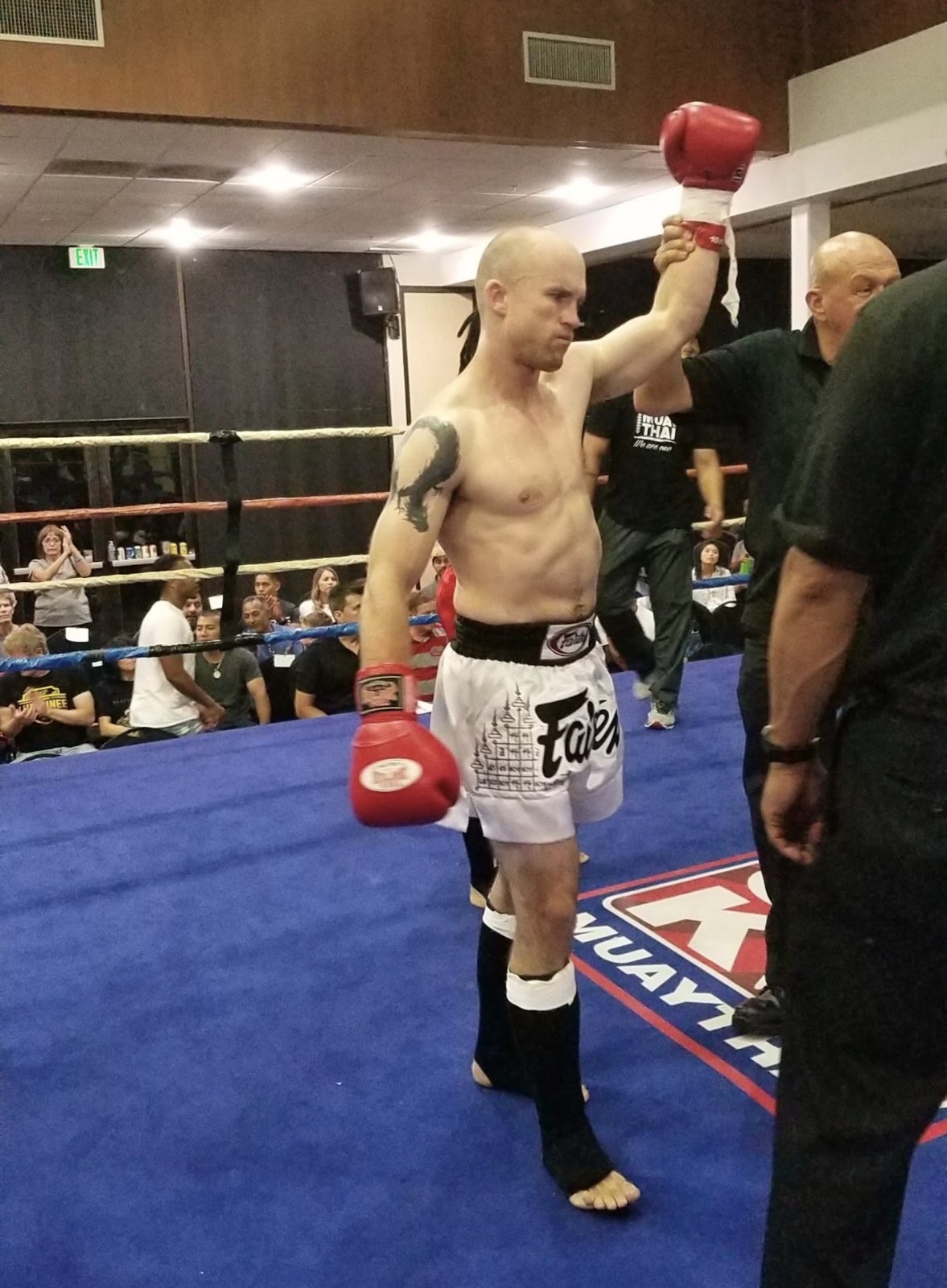
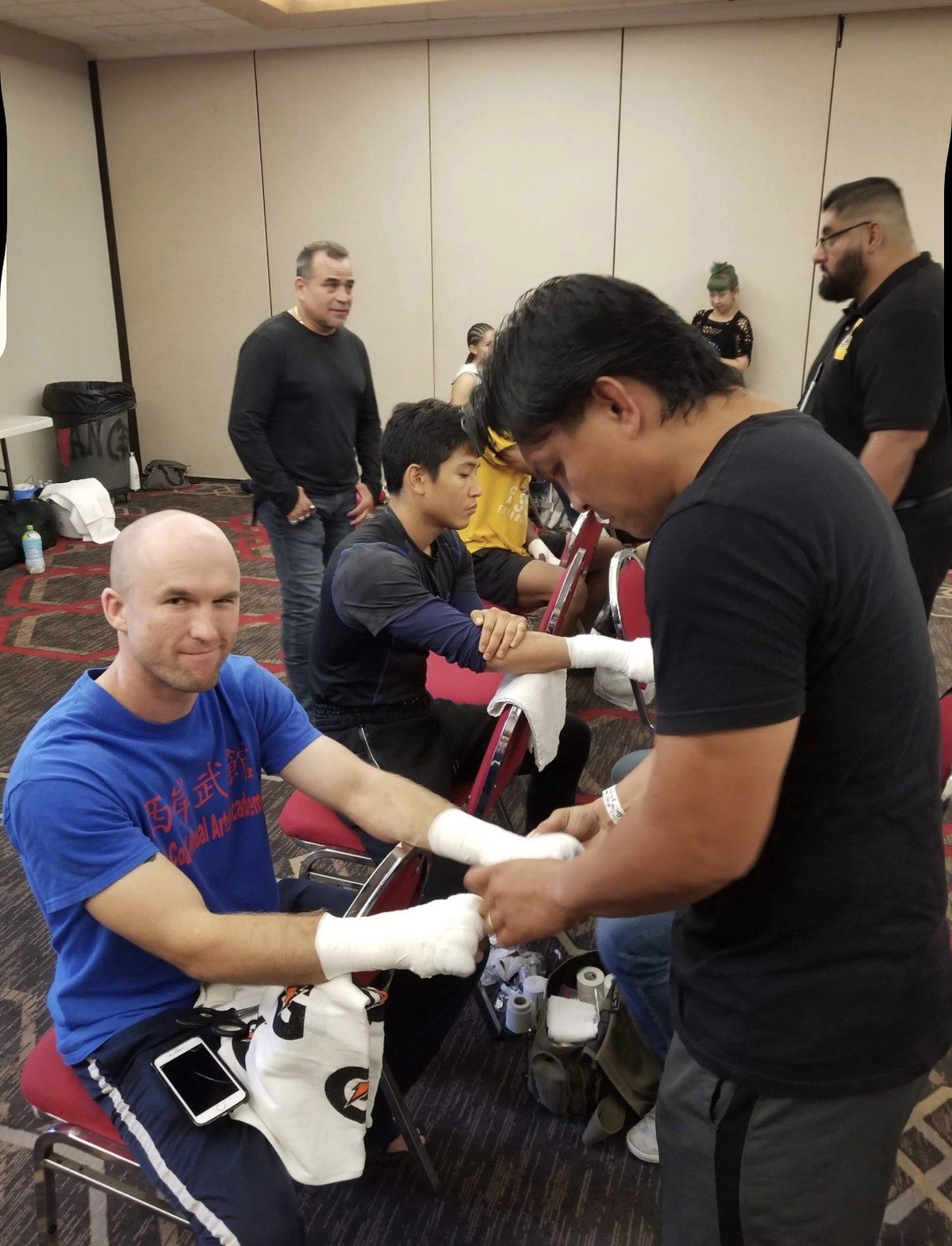
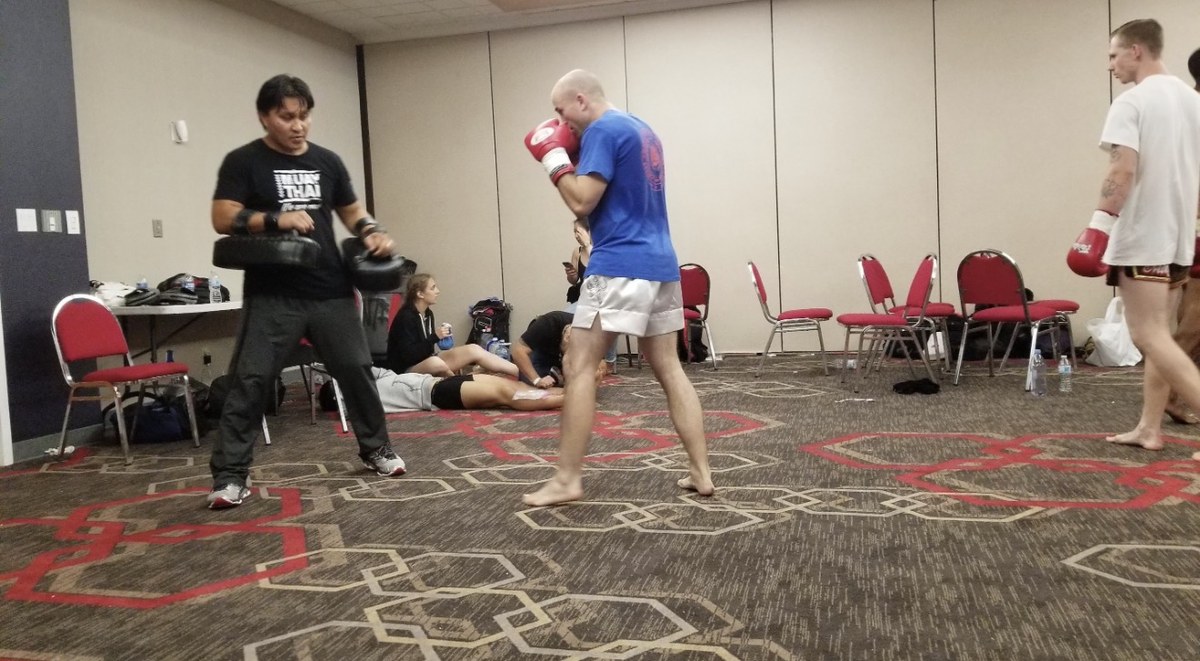
I eventually told him I wanted to have an amateur fight, something I’d always wanted to experience.
He helped make that happen.
My Amateur Fight
Today, Coach Mel runs private lessons out of my gym. He’s not affiliated with Blur Martial Arts. I’m just lucky enough to have him around as a resource, a mentor, and a friend.
And he’s a badass.
Not because he can beat people up, although he absolutely can.
But because he understands how to develop a fighter psychologically, not just physically.
That’s something I have tremendous respect for.
What Muay Thai Taught Me About Fear
One of the most important things Coach Mel taught me was what happens when you move from being mentally and emotionally out of balance to being able to access your complex motor skills again.
I still don’t think I do this as well as other people.
As I’ve said before, I don’t consider myself the best martial artist.
But I’ve noticed something interesting about myself when I spar.
The more rounds I go, the better I tend to get.
I’ve never been knocked out, probably because I flinch so damn much.
But as my opponent starts getting tired and my own adrenaline and norepinephrine begin to level off, I can finally access the skills I’ve spent more than 25 years developing.
I start fighting better and better.
That’s not necessarily something I’m proud of.
I’d love to be able to access those skills immediately.
But I know myself well enough to recognize that fear, stress, and my own physiology affect my performance.
And that brings me to the biggest difference between Muay Thai and self-defense.
Awareness, Consent, and Preparation: The Difference Between Fighting and Surviving
In the SPEAR System, Tony Blauer teaches a concept called Awareness, Consent, and Preparation (ACP).
These three things fundamentally change how we experience fear and violence.
And they’re three things you generally have before a Muay Thai fight.
Awareness: You know you’re going to fight. You know who your opponent is. You know when and where it’s happening.
Consent: You’ve agreed to participate. You chose to get into the ring, knowing there’s a possibility you’ll get hurt.
Preparation: You’ve trained for the fight. You’ve warmed up. You’re wearing the right equipment. You understand the rules. You’ve mentally prepared yourself for what’s coming.
Now, none of that means you won’t be nervous.
Sports psychology has plenty to say about how anxiety interferes with athletic performance.
And learning to perform while nervous is incredibly valuable.
That’s one of the reasons I love combat sports.
You can practice managing fear. You can learn to fight while mentally and emotionally out of balance. You can work on staying focused on what you’re going to do instead of obsessing over what your opponent might do to you.
But there’s a massive difference between experiencing fear in a fight you agreed to and experiencing fear when someone suddenly attacks you.
What happens when you don’t have awareness?
What happens when you haven’t consented?
What happens when you haven’t prepared?
What happens when someone pulls a knife, puts a gun to your head, or suddenly attacks you while you’re with your kids?
You don’t necessarily get the same psychological response you experience in the ring.
And assuming you will is a dangerous blind spot.
The problem isn’t that your Muay Thai skills don’t work. The problem is assuming you’ll be able to access those skills the same way when the circumstances are completely different.
That’s why we emphasize ACP at Blur Martial Arts.
Because self-defense isn’t just about what you know how to do physically.
It’s about what happens to you psychologically when violence finds you.
The Physical Blind Spots of Muay Thai
Let’s start with something obvious.
Punching someone in the skull with your bare hands is a great way to break or fracture your hand.
When you’re accustomed to throwing powerful punches with gloves and wraps, you develop neural patterns around that movement.
And those patterns don’t necessarily disappear because you’re suddenly in a self-defense situation.
I’ve accepted that if I’m attacked, I might throw punches instead of palm strikes.
It depends on the scenario.
But if I break my hand, how am I going to access an improvised weapon? How am I going to use that hand to protect my kids or get someone to safety?
That’s a problem.
Then there’s the environment.
What am I wearing?
Am I going to be able to throw the same kicks in those clothes?
What if I’m on slippery concrete?
What if someone twice my size is charging at me?
Do I really want to throw a long knee? Do I want to clinch with someone and occupy both of my hands?
What if they have a weapon?
And then there are the rules.
Muay Thai is a combat sport. There are target areas and techniques that aren’t allowed.
In my amateur fight, my opponent swept me, and later, when he threw a crappy middle kick, I instinctively hit him with a single-leg takedown from my STX Kickboxing training with Erik Paulson.
I lost a point for it.
Ironically, it didn’t cost me the fight. I still won by decision.
But it illustrates the difference between training for a sport and training for self-defense.
Then there are elbows.
Elbows are incredibly dangerous.
We rarely throw them with real contact in training because it’s so easy to split someone’s head open.
But if you’re not practicing something realistically, how confident should you be that you’ll access it under extreme stress?
Your go-to response under pressure is often going to be what you’ve practiced the most.
That isn’t always going to be the response that’s safest for the scenario you’re in.
What About a Good Old-Fashioned Douchebag Fight?
Now, if we’re talking about what I call a douchebag fight, or a dumb-boy fight when I’m talking to the kids, that’s a different story.
Two people get into an argument. Their egos get involved. Nobody wants to back down.
They’re not necessarily afraid for their lives.
Is Muay Thai useful?
Of course.
Is Brazilian jiu-jitsu useful?
Absolutely.
Judo? Wrestling? Boxing?
All incredibly useful.
But people underestimate how much fear can interfere with their ability to defend themselves.
Someone who goes looking for trouble often has a very different psychological experience than someone who suddenly finds themselves being victimized.
One person may be excited, angry, or looking for a fight.
The other may be terrified, confused, overwhelmed, or completely blindsided.
Those aren’t the same experiences.
And training as though they are can get people hurt.
Why I Still Love Muay Thai
Despite all these limitations, I love Thai boxing.
And I love teaching kickboxing at Blur Martial Arts.
Because there’s tremendous value in learning to experience impact.
You learn what it feels like to get hit.
You learn how resilient your body can be when you’re prepared, braced, and absorbing contact.
You learn that getting hit doesn’t necessarily mean you have to stop moving.
You learn how to manage your emotions, recover your composure, and keep working.
Those are valuable lessons.
But there’s a cost.
I’ve taken a lot of head trauma over the years.
Has it affected my memory?
Probably.
And I have a family history of dementia.
Knowing what I know now, would I have pursued so much full-contact training and taken so many shots to the head?
Probably not.
I have young kids, and I don’t know how much more head contact I want to expose myself to.
That’s another part of self-defense that people don’t talk about enough.
What good is training to protect yourself if the training itself is creating long-term damage?
We have to consider the consequences of how we train, not just whether our techniques work.
I still believe combat sports are incredibly valuable, especially when they’re taught by someone who understands fear management.
But they have blind spots.
And those blind spots need to be addressed.
Why Coach Mel Is Different
This brings me back to Coach Mel.
What makes him such a phenomenal coach isn’t just his technical knowledge.
It’s his understanding of people.
He didn’t throw me into the deep end and expect me to figure it out.
He gradually stress-inoculated me.
He helped me develop the ability to take contact, manage fear, and recover my composure.
He understood that I needed to be trained as an individual.
And that’s why I believe his approach has so much in common with what Tony Blauer teaches through the SPEAR System.
Both recognize that the psychological experience of violence matters.
Both understand that fear affects performance.
And both recognize that developing someone’s ability to manage fear is just as important as teaching them physical skills.
Now, Coach Mel and I are probably a little different from most people.
When some people hear screaming or realize something dangerous is happening, their first instinct is to get away.
My instinct is to figure out who’s getting hurt and move toward the danger to try to stop it.
That doesn’t mean I’m not afraid.
I flinch. I get scared. My body responds to stress like everyone else’s.
But if I believe my students or my kids are in danger, I know what my first instinct is going to be.
I’m going toward them.
A lot of people say they’ll do that.
I don’t know if they actually will.
But I know Coach Mel.
And I have tremendous respect for the kind of person he is, not just the fighter or coach.
So Is Muay Thai Good for Self-Defense?
Absolutely.
But it isn’t a complete self-defense system.
Neither is Brazilian jiu-jitsu, wrestling, judo, or any other combat sport by itself.
They can teach you how to fight.
They can teach you how to handle contact, manage pressure, and develop physical skills.
But they don’t automatically teach you how to recognize danger, avoid it, manage a sudden ambush, or make decisions when you’re terrified and completely unprepared.
That’s where Awareness, Consent, and Preparation become so important.
At Blur Martial Arts, I want our students to understand that the goal isn’t to become the best fighter in the room.
The goal is to recognize danger, make better decisions, manage fear, and get home safely.
Sometimes that means fighting.
Sometimes that means escaping.
Sometimes it means recognizing a problem early enough that you never have to fight in the first place.
And sometimes it means putting your ego aside and doing something that doesn’t look anything like what you’ve spent years practicing in a martial arts school.
That’s self-defense.
And if you live in 4S Ranch or Rancho Bernardo and want to train Muay Thai, and you haven’t reached out to see if Coach Mel will work with you, you’re making a huge mistake.
He’s a badass, a phenomenal coach, and one of the people who’s had the biggest impact on my development as a martial artist.
If you’re lucky, you’ll find an opening in his schedule.
See What BMA Can Do For Your Child
First class is free. No pressure, no contracts — just come see for yourself.
Get Our Class Schedule